Large Indian cities tend to be difficult places for pedestrians. In many areas, there are no sidewalks at all, and such sidewalks as exist tend to be in bad shape.

Short bridge on the Andheri-Ghatkopar Link Road’s sidewalk not far from the Marol Naka Aqua Line station. I had to cross this bridge four times a day during my February stay in Mumbai. Honesty compels me to add that some of what you see here is the result of a project to reconstruct the bridge. Most sidewalks in India aren’t quite as dangerous to walk on as the one shown in this photo, but many come close..
Pavers are often missing. Substantial holes are common. There are numerous manholes a centimeter higher than the general level of the sidewalk surface. Bulges from tree roots come along frequently. Piles of garbage and sleeping dogs are common obstacles, and so, occasionally, are sleeping humans. Furthermore, stores and kiosks that are supposed to be on the sidewalk’s edge have often taken over much of the right-of-way.1
Even more serious, it’s essentially impossible to cross major roads safely on foot. Drivers never feel that they have to defer to pedestrians. Red lights are often disobeyed, and left turns on red are apparently legal everywhere.2
There are exceptions in some new developments. Aerocity, a newish gated community consisting mostly of hotels near Indira Gandhi International Airport in Delhi, has little traffic and features proper sidewalks in excellent shape. The new Bandra-Kurla Complex in Mumbai similarly has good-quality sidewalks, although street-crossing is still fraught. And sidewalks are missing for a stretch on the otherwise pristine pedestrian path between the recently opened Aqua Line Metro station and the Complex. No doubt there are other exceptions that I don’t know about.

Pedestrian being forced to use the busy roadway while walking between the Aqua Line’s Bandra-Kurla Complex station and the Complex itself.
Mumbai’s seaside promenades—one old and one brand new—constitute another major exception. There may be no more substantial pedestrian-oriented spaces in all of urban India.

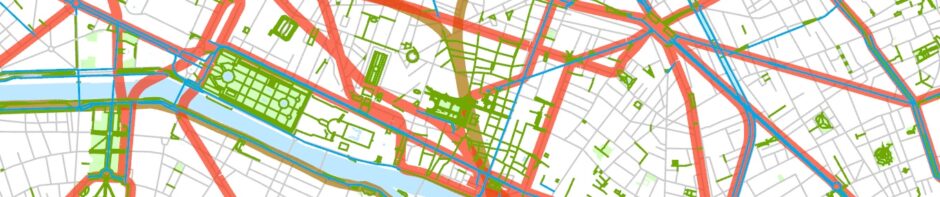
Map of South Mumbai emphasizing rail transit lines and pedestrian facilities. The nominal scale of the map is 1:50,000. That’s the scale it would have if printed on a 17-x-11-inch sheet of paper. GIS data are mostly derived from the Geofabrik version of OpenStreetMap. I’ve edited all the data. The map is clickable and downloadable, but note that this site’s host server does not allow images to be stored at their original resolution, and, if you zoom in too far, the image will be blurred.
The older promenade, Marine Drive Promenade, was constructed along with Marine Drive itself in the late 1930s; it opened in 1940.3 Marine Drive and the eponymous “Promenade” (walkway) run between Nariman Point in Mumbai’s old central business district and the beginning of the Malabar Peninsula.4 The Promenade is approximately 3.25 km long. The southern half or so of the Promenade is fairly wide (approximately 12 or 13 m) and is lined with trees. This part of the Promenade draws quite a crowd, especially late in the day as well as on weekends. There are always people there. Often, more of them are sitting than walking. but there are typically quite a few serious walkers and even a few runners.

Marine Drive Promenade. Note the art deco apartment buildings across Marine Drive itself.
The northern half of Marine Drive Promenade is not so wide and has less shade. It now borders the roof of the tunnel under Malabar Hill for several hundred meters. The tunnel roof provides a little shade in the early morning and protects the Promenade from the pollution and noise of automobile traffic.5

The northern part of the Marine Drive Promenade. The structure on the left is the roof of the tunnel under Malabar Peninsula.
The success of Marine Drive Promenade owes something to its pleasant views of the Malabar Peninsula and the Arabian Sea on the west and classic art deco apartment buildings and (at its southern end) CBD high-rises on the east. At its north end, new tall apartment buildings just inland become visible. Walking the complete Promenade provides a satisfying series of urban views. The Promenade is also a wonderful place for people-watching. In the late afternoon and early evening, the area has some of the same function as a classic Mediterranean passeggiata or corso. I know of no other place in urban India that functions so successfully as a pedestrian-oriented public space.
The Marine Drive Promenade, however, is not perfect. Except in the early morning, there isn’t much shade. Even more serious, it’s not easy to get to the Promenade on foot. You have to cross Marine Drive, which is often a difficult task. Except at or just north of Nariman Point, the Drive is usually jammed with vehicles. There are traffic lights that help, but, as everywhere in urban India, these are viewed by some drivers more as suggestions than as commands, and they do not in any case stop turning vehicles.
The Coastal Road Promenade, Mumbai’s newer and longer promenade, is, like the Marine Drive Promenade, a byproduct of the construction of a similarly-named parallel highway. The Coastal Road connects Marine Drive with the Western Express Highway in northwestern Mumbai. It runs from the tunnel under Malabar Hill on the south to an impressive bridge (called the Sea Link) over Mahim Bay in the north. Most of the Coastal Road runs on landfill along the Arabian Sea. Its construction has been heavily criticized on social-justice grounds. The road’s beneficiaries are largely people rich enough to own cars. Its victims include coastal fishermen whose livelihood was undermined by the road’s construction.6 Furthermore, the building of the Coastal Road has encouraged driving in a city with a major air pollution problem. The road does, however, make getting by car from northwestern Mumbai to the old central business district much speedier than it was.
Perhaps in part as compensation for the problems the Coastal Road has caused, the Coastal Road Promenade, a path on the Arabian Sea side of the highway, was added to the plans. Two separate segments opened during the summer of 2025. The Promenade now consists of approximately 5.25 km of paths. When the gap is filled, it should be 7.5 km long, and there are plans to add sections that would make it longer.
In some ways the Promenade is a model recreational path. It’s wide, 20 m in places. There’s a separate bicycle path. The just-completed surface is wonderfully smooth. Access, by Indian standards, is fairly easy. There are now four tunnels under the Coastal Road. Several additional tunnels are either under construction or planned for the near future.
A major problem is a nearly complete lack of shade. Some vegetation has been planted, but, of course, it hasn’t had time to grow very much. April, when I visited, is one of Mumbai’s hotter months. Temperatures in the afternoon were at least 35⁰ C. (95⁰ F.) every day I was there, and humidity was high. The air quality index was usually more than 100, and the sun was pretty fierce. When I first visited the Promenade, in mid-afternoon, I was a little surprised (although I shouldn’t have been) to find that almost no one was there.

The (rather empty!) Coastal Road Promenade in mid-afternoon. Note the construction barriers. The Promenade is open, but many features are still under construction.
There turned out to be a few more users early in the morning.

Runners, walkers, and cyclists on the Coastal Road Promenade early in the morning.
Even in the morning, most users were clinging to the shade provided by a tall building located across the Coastal Road. Few Indians are sun worshipers.

Early-morning visitors to the Coastal Road Promenade. The majority are sitting in a small area of shade, but some pedestrians and cyclists are braving the sun.
One factor in the modest usage may be that it’s not as easy to access the Promenade as one might have expected. The tunnels obviously help, but some have claimed that they present a security issue.7 And you still have to make your way through a construction zone in some places and then go up and down stairs or ramps. Perhaps more important, the Promenade is quite a ways from the nearest rail line and is not as close to dense housing as the Marine Drive Promenade.8
I’m told that the path’s highest usage levels occur at or just after sunset. But the Promenade never gets the kind of use that the Marine Drive Promenade does. No doubt, when the Promenade’s components are fully connected and more tunnels are opened, it will attract more people, especially during cooler times of the year. The fact that some new housing is going up in places just east of the Coastal Highway will also add to the customer base.
In other words, the Coastal Road Promenade is still a work in progress. But, in a country where there are few comfortable urban spaces for pedestrians, it’s an impressive addition to Mumbai’s infrastructure.
- This is no secret to the residents of Indian cities, and many people (and groups) are trying to rectify the situation, but they face an uphill battle. See, for example, the description of the work being done to improve the walking environment of Mumbai in: Pallavi Shrivastava, The city observed : notes from an unfolding India. Lajpat Nagar, Sahibabad : Copal Publishing Group, 2015. Especially pages 22-24.
- Driving is on the left in India. Many Western and East Asian countries—using traffic lights and (in some places) crosswalks and stop signs—have figured out how to allow pedestrians to cross urban streets with some degree of safety. India (along with many other countries of the Global South) just hasn’t. The fact that widespread automobile ownership is recent may be one of the reasons for this phenomenon, but I suspect that difficult-to-change cultural factors are also involved. Whatever the reason, might tends to make right on the roads of India (and many other places as well). In planners’ language, automobile “throughput” is prioritized over pedestrian safety. I acknowledge that this happens in many parts of the United States as well.
- Marine Drive is now known formally as the Netaji Subhash Chandra Bose Road.
- The use of the somewhat old-fashioned British term “promenade” for a waterside walkway seems a little strange to American ears. It’s presumably an inheritance from the 19th-century British Empire. The word is used with the same meaning in Hong Kong.
- One of the characteristics of Indian roads is that they’re extraordinarily noisy. Many drivers seem to honk a dozen times a minute.
- See, for example: Amrit Dhillon, “‘Exclusively for the elite’: why Mumbai’s new motorway is a symbol of the divide between rich and poor,” The Guardian (21 January 2026).
- Linah Baliga, “Coastal road promenade users flag security gaps, commercial exploitation,” Hindustan Times (27 November 2025).
- The closest Metro station to the Coastal Road Promenade is the Acharya Atre Chowk station on the Aqua Line, which is around 1.4 km from the Haji Ali tunnel, but, until the northwestern exit (I believe B4) is open, this route requires crossing a very difficult-to-cross arterial. For the moment, I think the easiest way to get between the Metro and the Promenade on foot is to use the Worli station, which is approximately 1.6 km from the Haji Ali tunnel. The sidewalk is often highly irregular, but there are no really difficult street crossings.