The Petite Ceinture (“little belt”) was a mid-19th-century railroad line that ran in a circle around Paris. Its right-of-way was just inside the Boulevards des Maréchaux, which in turn were generally just inside the 19th-century city fortifications where the Boulevard Périphérique runs today. The Petite Ceinture had only a few surface sections. Most of it was on an embankment or in a culvert (trench) or tunnel. (Much of outer Paris is rather hilly.)
The line was built to facilitate the transfer of train cars among the dozen or so railroads that connect Paris with the rest of the country. The Petite Ceinture also had a metro-like passenger service between 1862 and 1934. For many years, trains ran with fifteen-minute headways. In the 19th century, before electrification of urban railroads was possible, the Petite Ceinture was widely considered an interesting model for cities that were planning to provide an urban railroad service. But the line was too far from the dense city center to attract a huge number of customers, and use dwindled with the opening of the Métro and an elaborate system of city tramways and (later) buses.
The Petite Ceinture maintained freight service in some places for quite a while, and a section in northwestern Paris was used for RER Line C in 1988. There are also a couple of short sections where mainline railroads still use the Petite Ceinture right-of-way for switching, but approximately 90% of the line was essentially abandoned by the beginning of the 21st century.
There was talk at the time of using the Petite Ceinture’s right-of-way for a circumferential rail transit route, but planning authorities, entranced by the “civilizing” role of street-level trams, decided to put tram lines 3 and 3a in the Boulevards des Maréchaux. Part of Line 3 was opened in 2006. The Petite Ceinture’s right-of-way remained in place, theoretically off-limits but often used by Parkour enthusiasts and other urban explorers. Vegetation and wildlife (along with graffiti) flourished in the corridor.
Since the late 2010s, there has been a move to turn parts of the right-of-way into publicly accessible recreational paths. SNCF, the French National Railroad, which owns the land, has never been very enthusiastic about this and has insisted that the only reversible changes be made. As it happens, this jibed pretty well with a feeling that it would make sense to keep the right-of-way in its semi-wild state.1 Rails, ties, and ballast were thus left in place. Typically, one track was filled in with hard-packed dirt so that it could easily be walked on, while the other track retained its vegetation.

The Petite Ceinture in the 20th arrondissement. Note that both sets of tracks have been left in place, but the left-side tracks have acquired a hard-packed dirt walking surface.
It was rainy and cool during the week I spent in Paris, and the hard-packed dirt was often filled with puddles. Walks along the Petite Ceinture are not for everyone.

Puddles on the walking path along the Petite Ceinture in the 12th arrondissement.
There are variations in this pattern. In the 16th arrondissement, in Auteuil, for example, the tracks have mostly disappeared, and the Petite Ceinture’s right-of-way consists of a trail through the woods in a narrow trench surrounded by substantial apartment buildings.

Tracks are hard to spot in the 16th arrondissement’s stretch of the Petite Ceinture.
Bridges over streets, where rail tracks often had openings to ground level, required a special approach.

Bridge over the Canal de l’Ourcq in the 19th arrondissement that has not yet been used for a recreational path. Photo taken in 2021.
Typically, a metal grate that supports passersby has been laid down.

Bridge over Avenue Daumesnil in the 12th arrondissement.
The recreational paths along the Petite Ceinture’s right-of-way are, in other words, completely different from the walkways of the Coulée verte René-Dumont (the former Promenade plantée) and its descendants, the High Line in New York and the 606 Trail in Chicago. The latter are the scenes of high-end designer horticulture. The trails carved out of the Petite Ceinture are supposed to be rough and natural-looking, even if the landscape was to a large extent the result of work by 19th-century railway engineers.
Some station buildings survive. At least one station (in the 15th arrondissement) has been converted into a café.

A café carved out of a station on the Petite Ceinture in the 15th arrondissement. The wooden boards over the tracks make up an alternative walking surface.
In the 18th arrondissement, a café with a small performance space has been created from scratch.

A new café along the Petite Ceinture in the 18th arrondissement.
Providing means of access has been an important part of the renovation process. Because the tracks are typically at a different level than the streets, simple ramps to the Petite Ceinture have been possible only in a few places. Generally, it’s been necessary to build metal stairways and/or elevators—which are costly and (in the latter case) require maintenance.

Stairway down to a section of the Petite Ceinture in the 18th arrondissement that sits in a trench.
Many parts of the Petite Ceinture are surprisingly invisible from surrounding buildings, and it was not expected in any case that there would be a huge number of users, so security has been felt to be a potential problem. All of the converted sections of the line have thus been gated. Access is possible only during daylight hours, after which the gates are locked.

Sign at the Petite Ceinture’s Rue des Meuniers gate in the 12th arrondissement. Note the complicated opening hours.
None of the tunnel sections has been opened to the public. There has been a sense that they would require considerable renovation and present a serious security issue.2

A closed-off tunnel in the 15th arrondissement section of the Petite Ceinture. Dog-walking along the Petite Ceinture is theoretically forbidden, but violators are common.
The process of conversion has been rather slow and piecemeal. As of mid-2026, there are open sections of the Petite Ceinture in nine arrondissements, some longer than others. The longest open section is in the 12th arrondissement. It’s 1.67 km (a little more than a mile) long.

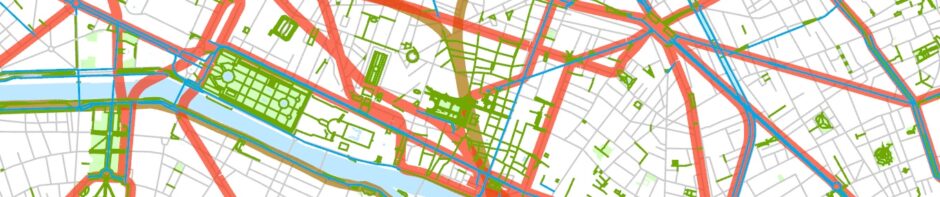
Map of Paris and some of its inner suburbs emphasizing the recreational paths that have been carved out of the Petite Ceinture. The map also shows Métro, RER, and tram lines and pedestrian facilities other than those in the Petite Ceinture’s right-of-way. The nominal scale of the map is 1:60,000. That’s the scale it would have if printed on an 8-1/2-x-11-inch sheet of paper. GIS data are mostly derived from the Geofabrik version of OpenStreetMap. I’ve edited much of the data. The map is clickable and downloadable, but note that this site’s host server does not allow images to be stored at their original resolution, and, if you zoom in too far, the image will be blurred.
The Petite Ceinture has become a minor tourist attraction. The Association pour la Sauvegarde de la Petite Ceinture de Paris et de son Réseau Ferré has put up a website that describes it. The Petite Ceinture is also mentioned on some more general tourist sites. But I was struck on all the sections I visited at how few visitors there were. Paris is, of course, one of the most walkable places on earth. Its sidewalks are often crowded and (except in the middle of the night) are only rarely empty. But the sections of the Petite Ceinture that have opened to the public remain (as they were supposed to) lightly used. I was the only user when I visited segments in the 16th and 20th arrondissements (and brought my American anxiety about street crime in empty public places).
There are plans to continue the conversion process and to open new sections to the public. This process is likely to continue to be slow, because it costs money to do even a modest renovation, and because SNCF has remained a reluctant partner. However, because of the tunnel problem and the use of parts of the line (mostly in the northwest) by active railroads, it will presumably never be possible to complete the circle.
- See, for example: Cécile Cazenave, “Petite ceinture, le Paris de la nature,” Le Monde (1 July 2023).
- Although Paris has acquired an 800-m-(half-mile)-long pedestrian and cyclist tunnel, the Tunnel des Tuileries, as a result of the pedestrianization of a one-way limited-access highway along to the North Bank of the Seine. So far as I can determine, there have not been major security issues in the Tunnel des Tuileries, but this facility is often crowded: it sees a great deal more use than the Petite Ceinture.