-
Recent Posts
- Eastern Canadian cities open several new, mostly suburban rail transit lines
- Parts of the Petite Ceinture are being turned into recreational paths
- Mumbai’s seaside “promenades”
- Two new transportation facilities in Mexico City: El Insurgente suburban rail line and Cablebús Line 3
- Mumbai’s new Aqua Line
Categories/Places/Dates
Abu Dhabi Atlanta Austin Bangkok Bordeaux Boston Buenos Aires Calgary Chicago Dallas Delhi Denver Detroit Doha Dubai Hamburg Harbin Havana Hong Kong Honolulu Incheon Istanbul Jakarta Jersey City Kenosha Kitchener Kuala Lumpur Kyoto Lille Lima Lisbon London Los Angeles Lyon Madrid Marseille Mexico City Miami Miami Beach Milan Milwaukee Montréal Moscow Mumbai New Orleans New York Nice Oak Park Ottawa Panama City Paris Philadelphia Quito Reykjavik Riyadh Rome San Francisco San José (C.R.) Santiago (Chile) Seville Singapore St. Louis Strasbourg São Paulo Tashkent Tempe Tokyo Toronto Toulouse Vladivostok
-
Archives
archives
Recent Comments
- Christopher Winters on Skyline, Honolulu’s new elevated railroad
- Pete on Skyline, Honolulu’s new elevated railroad
- Anonymous on The geography of carfree households in the United States revisited
- Anonymous on The geography of carfree households in the United States revisited
- Scott Daley on Tale of two cities: Milan and Rome
Meta
Tag Archives: Chicago
The resilience of commercial streets in walkable urban neighborhoods
It’s been suggested that the Coronavirus Pandemic will turn out to be a disaster for stores on commercial streets in walkable neighborhoods. Most of these stores have had to close or at least to limit their operations during a lockdown … Continue reading
Another book “superstore” closes
I was a little shocked to discover in the course of a walk further south than I’d been for two months that the Barnes & Noble at … Continue reading
Change in population by “race” and Hispanic/Latinx status, Chicago area, 2010-2014/2018
The Census Bureau released the 2014/2018 American Community Survey (ACS) tract-level data last December, and I’m afraid I’ve been a little slow to download and analyze any of the numbers. One reason is that I didn’t think that there would … Continue reading
Pedestrian life in Chicago during the Coronavirus Pandemic
There have been hundreds of newspaper stories describing the emptiness of American cities during the Coronavirus Pandemic. This view doesn’t jibe with what I’ve observed at all. I’ll gladly admit that my experience during six weeks of “lockdown” (ever since March … Continue reading
Was Chicago still building “too much” in 2018?
I’ve put up three previous posts in which I pointed out that, given Chicago’s continued population losses, there was an enormous amount of residential building in the Chicago urban area, or at least an enormous amount of residential-building permit-filing. This … Continue reading
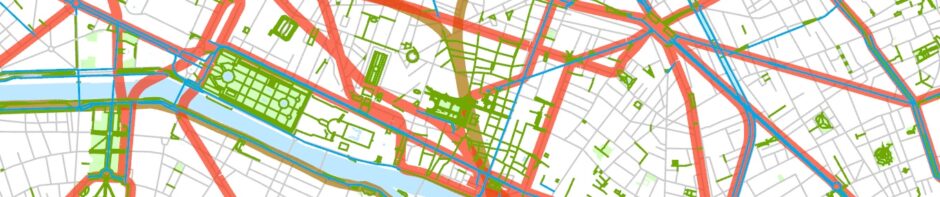
Using OpenStreetMap to map urban pedestrian facilities
Most of the maps on this site were created at least in part with GIS data from OpenStreetMap (OSM). OSM (for those who do not know) consists of GIS data—that is geographic data in a format usable by computer mapping … Continue reading
Posted in Urban, Transportation, Pedestrian infrastructure
Tagged Chicago, Hong Kong, Dubai, Kyoto, Lyon, Moscow
Leave a comment
Change in population by “race” and Hispanic status, Chicago area, 2010-2013/2017
The Census Bureau released the 2013/2017 American Community Survey (ACS) tract-level data last month. I’ve used these data to map tract-level changes in population by “race” and Hispanic status between 2010 and 2013/2017 for the Chicago area. These maps are … Continue reading
Was Chicago still building “too much” in 2017?
I put up posts in 2016 and 2017 in which I pointed out that, given Chicago’s continued population losses, there was an enormous amount of building in the Chicago urban area, or at least an enormous amount of building-permit filing. … Continue reading
Chicago hospital thinks it’s in Schaumburg*
Thorek Hospital is a 118-bed hospital on Chicago’s North Side. It is most definitely not a major research institution. It ranks as “below average” in U.S. News and World Report ‘s evaluations of U.S. hospitals. Many (although not all) of its … Continue reading
Change in population by “race” and Hispanic status, Chicago area, 2010-2012/2016
The Census Bureau released the 2012/2016 American Community Survey (ACS) tract-level data last month. I’ve used these data to map tract-level ethnic changes between 2010 and 2012/2016 for the Chicago area. These maps are comparable to the 2000-2010, 1990-2000, and … Continue reading